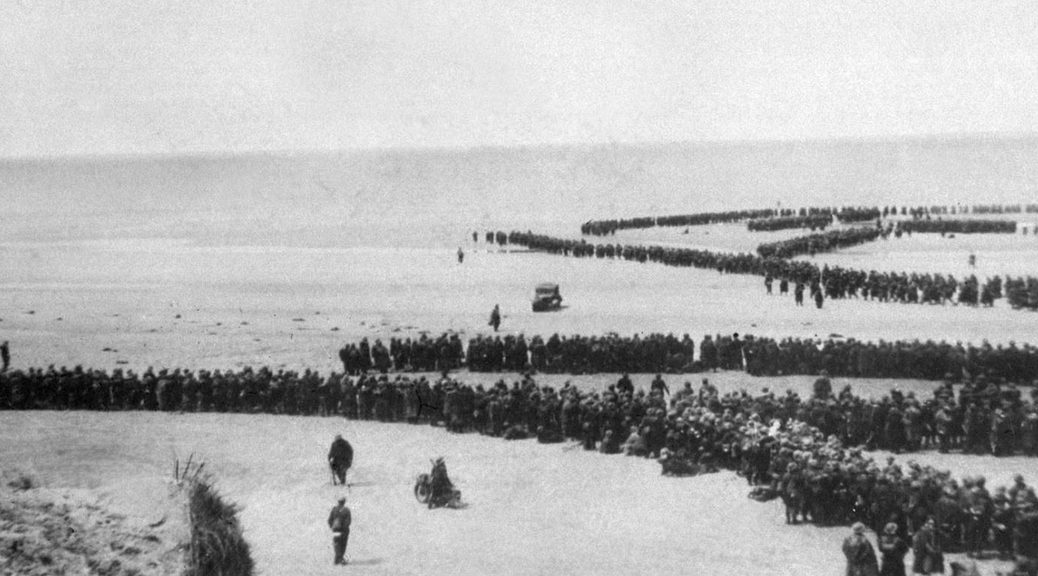
LEST WE FORGET: In search of an unknown soldier
As I sit in my study I have a framed group of World War II medals hanging on the wall in front of me that record my maternal grandfather’s wartime service. But my other grandfather was a mystery. For this blog’s first guest contribution, I’m handing over to my husband Christopher, for whom marrying into the family was evidently not enough—as I have so few living relatives, he needed to investigate the dead ones too … and then find a few more I knew nothing about. Here he tells the story of his search for the grandfather neither my father nor I ever knew.
Simon
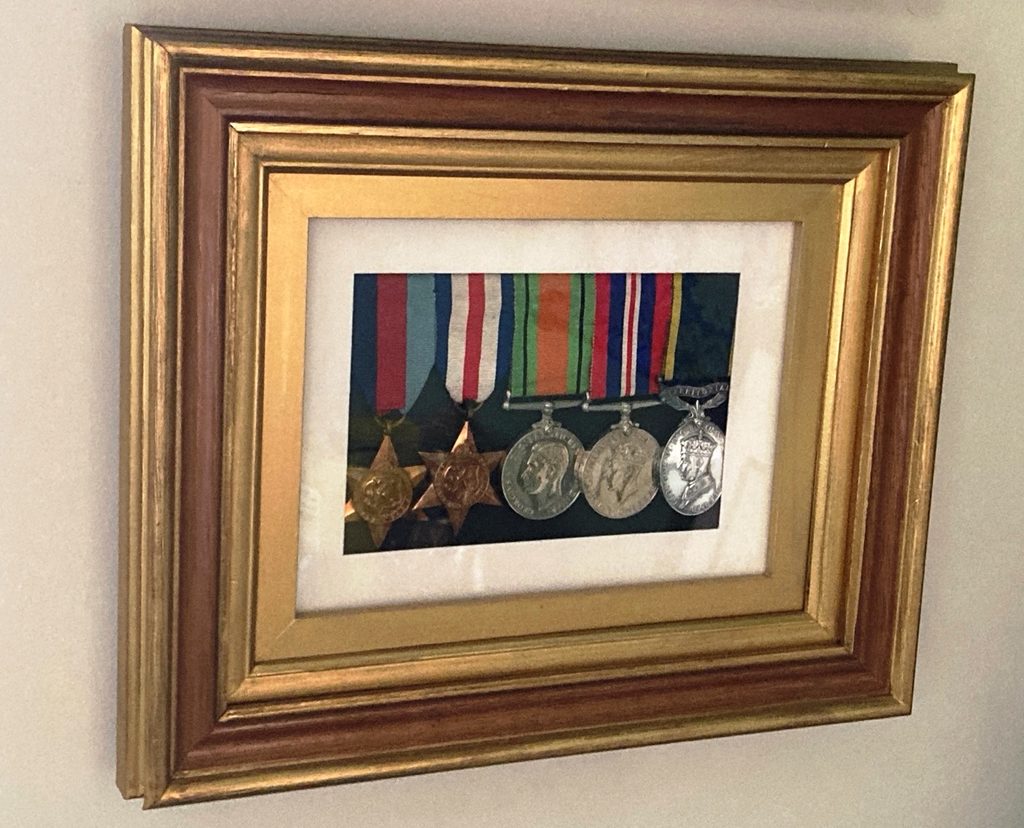
THE UNKNOWN SOLDIER
When I began researching Simon’s genealogy, there was one glaring gap: the identity of his paternal grandfather. Simon’s father Roger Ord Bostic was born in Rushden, Northamptonshire in 1941, in the midst of the Second World War. Roger’s mother, Hazel Shatford, was 24 years old and unmarried. Hazel told her family that Roger’s father was a soldier, they had become engaged, but he had been sent away to fight before they could marry. According to her account, he had been killed in the war without ever knowing about or meeting his son. The surname Ord was known – it was Roger’s middle name – but Hazel either never revealed his first name or nobody in the family remembered it. Nothing more was known about his family except Hazel’s claim that she had approached the family after Roger’s birth, but they hadn’t wanted to know her. Over many years, I investigated Ords who had died during the war—there were quite a few—but eventually gave up trying to solve the mystery.
THE DNA
DNA testing offered a new possibility. Simon and I both initially tested with 23andMe, but Simon’s results revealed no relatives who could shed light on his paternal grandfather’s identity. Then, a few years ago, we took AncestryDNA tests. Here, suddenly, was the breakthrough I had been looking for.
DNA tests can show your likely genetic/ethnic origins (ie where your ancestors came from) but can also show how closely you are related to other people who have taken tests. The closeness of the relationship is measured in centimorgans (cM) – how much DNA two people share. Generally, the greater the amount, the closer their biological relationship. The table below (from https://dnapainter.com/) shows the average midpoint and the possible ranges:
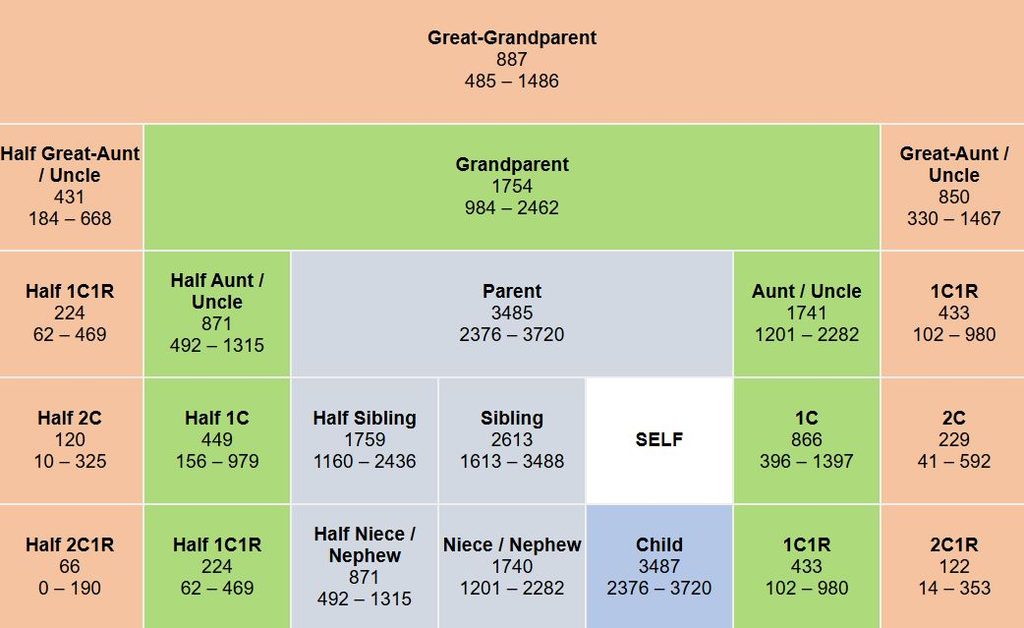
These ranges overlap (ie one specific amount of cM can mean any of a number of different relationships), so to be able to work out the plausible relationships one needs a family tree. When you know which generation the match falls into compared to you, it limits the possible options, making it easier to work out the correct relationship. In the chart, the “full” relationships on the right assume both parents are shared, both grandparents etc. The “half” relationships assume just one of the parents/grandparents etc is shared.
Simon’s closest match was a David Ord, with whom he shared 412 centimorgans. But David had not developed a tree linked to his DNA test so I couldn’t be sure of his generational position in relation to Simon.
THE GREAT-GRANDPARENTS
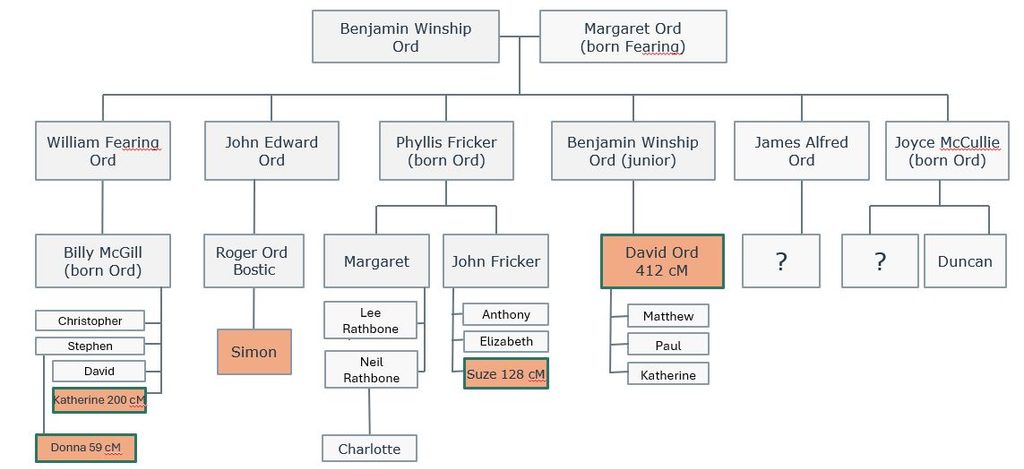
Luckily, two other relatively close matches (but with different surnames – Suze Fricker and Donna Astill) had published their family trees. And sure enough, they both showed descent from the same couple: Benjamin Winship Ord and Margaret Ord (née Fearing). The name Ord meant I was now confident that I had found the right family, though not yet the right man. Using Donna and Suze’s research, and doing rather a lot of my own, I constructed a complete tree of all Benjamin Winship Ord’s descendants and compared the DNA matches across its branches. An additional DNA relation turned up in Donna’s tree, her aunt Katherine. The cM numbers don’t lie, and the known relationship of these four matches to each other meant Benjamin and Margaret had to be Simon’s great-grandparents.
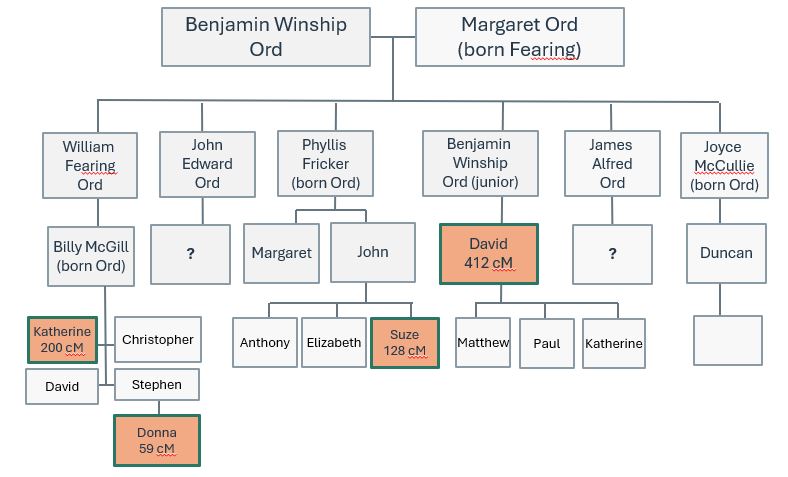
This couple had four sons and two daughters (not counting three children who had died in infancy). Obviously the daughters were ruled out. So which of the sons was Simon’s grandfather?
The eldest son was William Fearing Ord. His only daughter Billie Fearing Ord (married name McGill) had emigrated to Australia, and the matches with her descendants meant her father could possibly be Simon’s grandfather. If Roger had been Billie’s half-brother, Katherine would be a half first cousin, and 200 cM falls just inside the possible range for this relationship. Donna, however, falls slightly out of the possible range for half first cousins once removed, making her more likely a second cousin once removed. Then again, McGill family history described William Fearing as having abandoned his wife. So this settled nothing. The Australian cousins had lost touch with their UK family so could shed no further light on the situation.
The eldest daughter Phyllis Ord married Ernest John Fricker and had a granddaughter Suze who showed 128 cM of DNA match. 128 cM lies within the range of a full second cousin relationship. Sadly, both Phyllis’s children had fairly recently died, taking any possible family secrets with them.
The third son, also named Benjamin Winship Ord, was David Ord’s father. His wife Sarah McMillan was from Northern Ireland, so he moved to Belfast where David grew up. David’s 412 cM match with Simon again (only just) ruled him out as Simon’s half-uncle, but was consistent with his being Roger’s full first cousin (ie Simon’s first cousin once removed). Sadly, David died in 2017. His family were unable to supply additional clues.
The youngest daughter Joyce Ord married Maurice McCullie – but none of that line had tested for DNA.
This left John Edward Ord and James Alfred Ord, known as Jimmy (according to Phyllis’ daughter-in-law), as potential grandfathers. Jimmy’s youth made him less likely (two years younger than Hazel), although I could not conclusively exclude him and was frustratingly unable to trace his descendants. He married Joan Horne in 1943.
So all this left John Edward Ord. As I researched him further, he seemed a much stronger possibility. Born in December 1909, he was 30 when Roger was conceived in October 1940, a few years older than Hazel. I next discovered that he had been a soldier before the war, had been captured in North Africa in 1941, just months after Roger’s birth, and had remained a prisoner until the war ended. This was a major breakthrough. His prolonged absence could explain why he had not returned to Hazel or become part of his son’s life, and why she thought he had died.
I tried requesting his full records from the army archives a few years ago, but without success. His full service record was not yet accessible as public release is restricted till 115 years after birth. However, that anniversary passed at the end of 2024 and before too long his full army record appeared on Ancestry.
The first thing that leapt off the page was his physical description on enlistment at age 19 years and 7 months: 5 ft 8, grey eyes and auburn hair. This exactly matches Roger at a similar age, and indeed Simon – apart from the height!

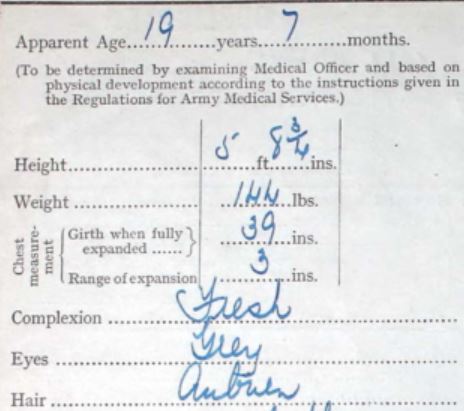
The records identified his regiment during WWII as the 2nd Regiment of the Royal Horse Artillery, whose movements I then traced through the official war diaries held at The National Archives. And finally the breakthrough I had hoped for: the 2nd regiment of the Royal Horse Artillery were based in Hazel’s home town of Rushden, Northamptonshire from July 1940 and during the October in which Roger was conceived.
I also found a copy of the war memoirs of Christopher Seton-Watson “Dunkirk–Alamein–Bologna” published in 1993. He was an officer in the 2nd RHA, and his movements and experiences exactly match those of John Edward. These confirm the posting to Rushden.
The DNA had identified the family; the military records now placed John Edward in the right town at precisely the right time. Although this was not absolute proof, the combined genetic, physical, documentary and geographic evidence made a compelling case that John Edward Ord was Roger’s father and Simon’s grandfather. Theoretically James Alfred Ord might have served in Rushden at the same time, but the chances are slim. But this option needs to be ruled out once his records are obtained.
Here is the full family tree that I have been able to construct:
THE SOLDIER IDENTIFIED
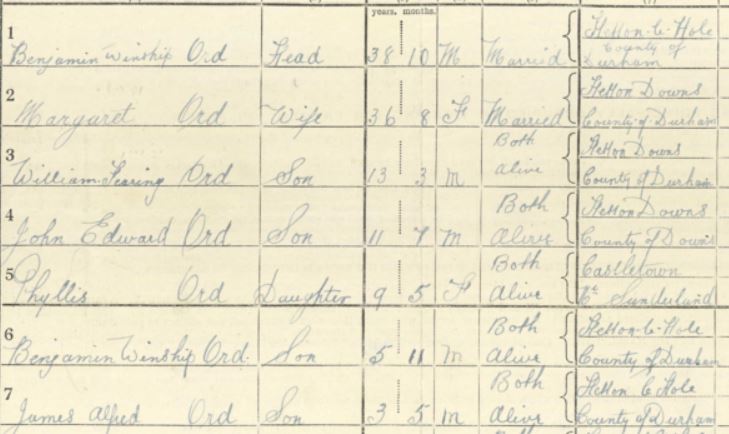
John Edward Ord was born on 11 December 1909 at Hetton-le-Hole, County Durham, the son of Benjamin Winship Ord, a tailor who later worked as a miner, and Margaret Fearing. He came from a family whose roots lay in the Durham mining district, and his first recorded occupation was a miner.1 The list of his father’s family below is from the 1921 Census.
John Edward enlisted in the Royal Artillery at Durham on 20 July 1929, aged nineteen, and received army number 794427. His original engagement was for three years of full-time service, followed by nine years in the Army Reserve. Alongside military training, he obtained army education certificates at Woolwich: third class on 28 August and second class on 22 November. On 9 November he joined D Battery, Royal Horse Artillery, then part of the 3rd Brigade RHA.2
Artillery service involved the use and maintenance of guns, ammunition and transport. John Edward began as a gunner and soon gained his first appointment as a non-commissioned officer. He completed his regular service in July 1932 and passed into the Army Reserve as a lance bombardier (artillery equivalent of lance corporal).
Between the 1921 census (when the family were in Hetton-le-Hole, Co Durham) and the eldest son William Fearing Ord’s marriage in 1933 (in the Hatfield registration district), the Ord family moved from County Durham to Welwyn Garden City in Hertfordshire. By the wartime years the family address was 33 Knella Road where his father was listed as next of kin.3
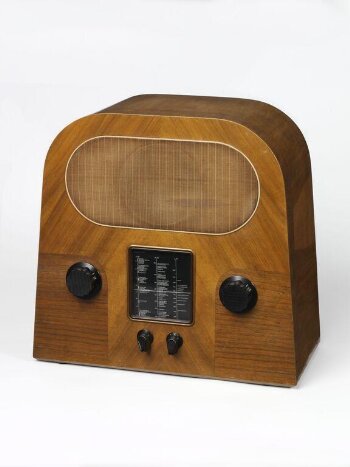
For nearly seven years he lived as a civilian while remaining liable to recall. He appears to have found work as a radio mechanic, almost certainly for the Murphy Radio Company, one of the largest employers in Welwyn.
OFF TO FRANCE WITH THE BRITISH EXPEDITIONARY FORCE
Buried in his military record were brief handwritten annotations tracing his movements. In 1940 he was serving with the British Expeditionary Force in France. Then came a phrase: “evacuated from BEF”, followed by a date in pencil I struggled to decipher but appeared to be 1 June 1940. Elsewhere, a summary of his postings supplied the missing clarity: his service with the BEF ended on 4 June 1940, and his next period of service began on 5 June in England. That word, “evacuated”, and those dates sent a shiver down my spine. This was Dunkirk. Simon’s grandfather had been among the men brought home in that extraordinary evacuation—and on its final day. A few terse entries in an army record had suddenly connected this unknown man to one of the most momentous events of the war.
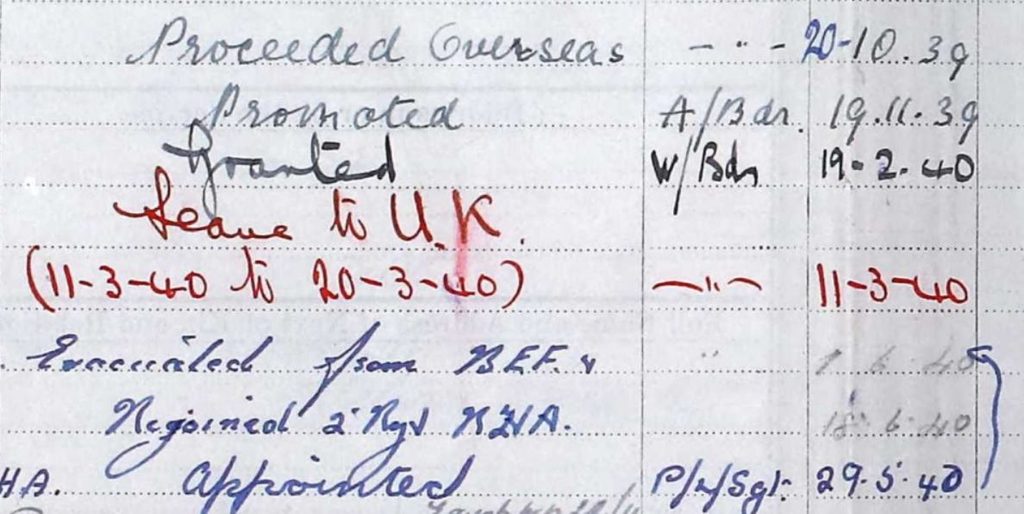
I managed to fill in more detail from the regimental War Diaries and Christopher Seton-Watson’s detailed accounts.
As war approached, he was called back on 15 June 1939 for training until 12 August after which he was mobilised at Bulford on 2 September and posted to 2nd Regiment Royal Horse Artillery. He returned to the army as an experienced former soldier and as an NCO. 2RHA had two batteries, H/I and L/N, the latter being John Edward’s wartime battery comprising L (Néry Troop) and N (Eagle Troop).
On 20 October 1939 the Regiment embarked for France. The regiment spent the winter of 1939–40 billeted and training near Lille. John Edward was soon promoted to acting bombardier (equivalent to corporal) and then full bombardier on 19 February 1940, after a short attachment to a military school in January. His promotion was followed by ten days’ leave in Britain beginning on 11 March.4
Soon after his return, 2RHA moved in mid-April to Toufflers, close to the Belgian frontier. In “Dunkirk – Alamein – Bologna” Christopher Seton-Watson describes the regiment’s time with the BEF (he was with John Edward’s regiment, but attached to H/I Battery). His account is the basis for the following summary.
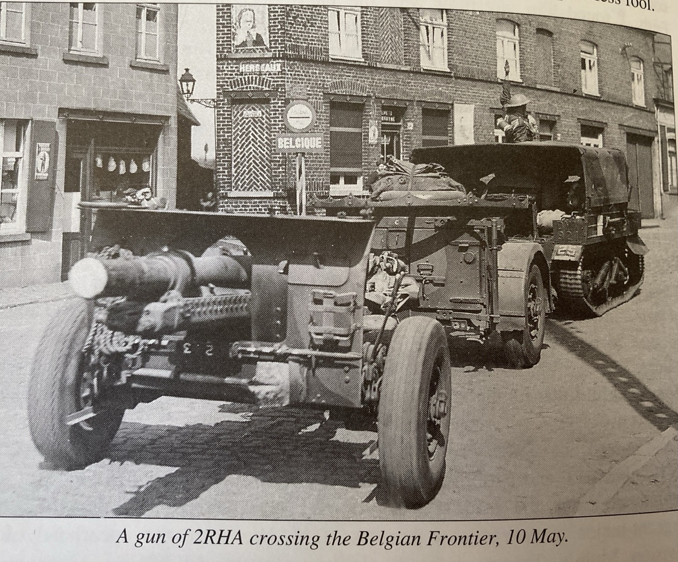
Following a German attack on 10 May, the Regiment’s guns advanced through Belgium towards Louvain to support the British position on the River Dyle. The advance gave way to a fighting retreat, first past Brussels and the Dendre, then towards the Escaut. After crossing back into France near Tourcoing, the regiment was drawn towards Hazebrouck to meet the threat to the BEF’s flank and rear. On 27 May its guns were fighting around Morbecque.5
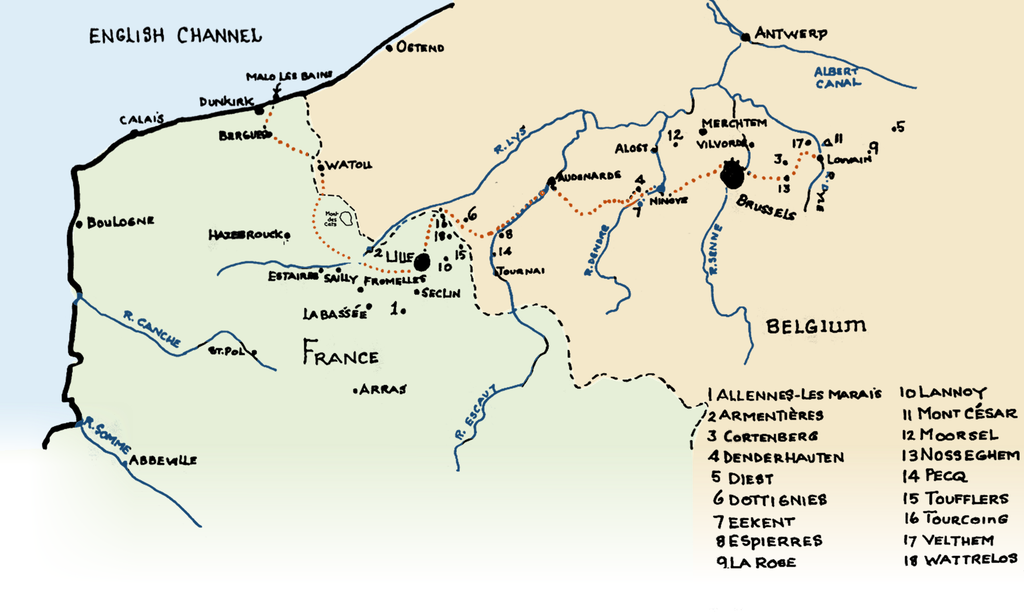
(Map from Christopher Seton-Watson)
The last days of the retreat brought blocked roads, abandoned equipment and parties of men trying to reach Dunkirk. On the night of 28–29 May, L/N Battery’s commander brought orders to Seton-Watson’s party to help defend Mont des Cats before making for the coast. At Dunkirk, officers and troops were scattered in the chaos. Seton-Watson’s group eventually embarked from the eastern mole on HMS Codrington on the evening of 30 May and reached Dover early on 31 May. John Edward remained on the Continent longer: his evacuation was recorded as either 1st or 4th June – the last day of the evacuation – but whether from the beach, harbour or via a small boat we don’t know.6
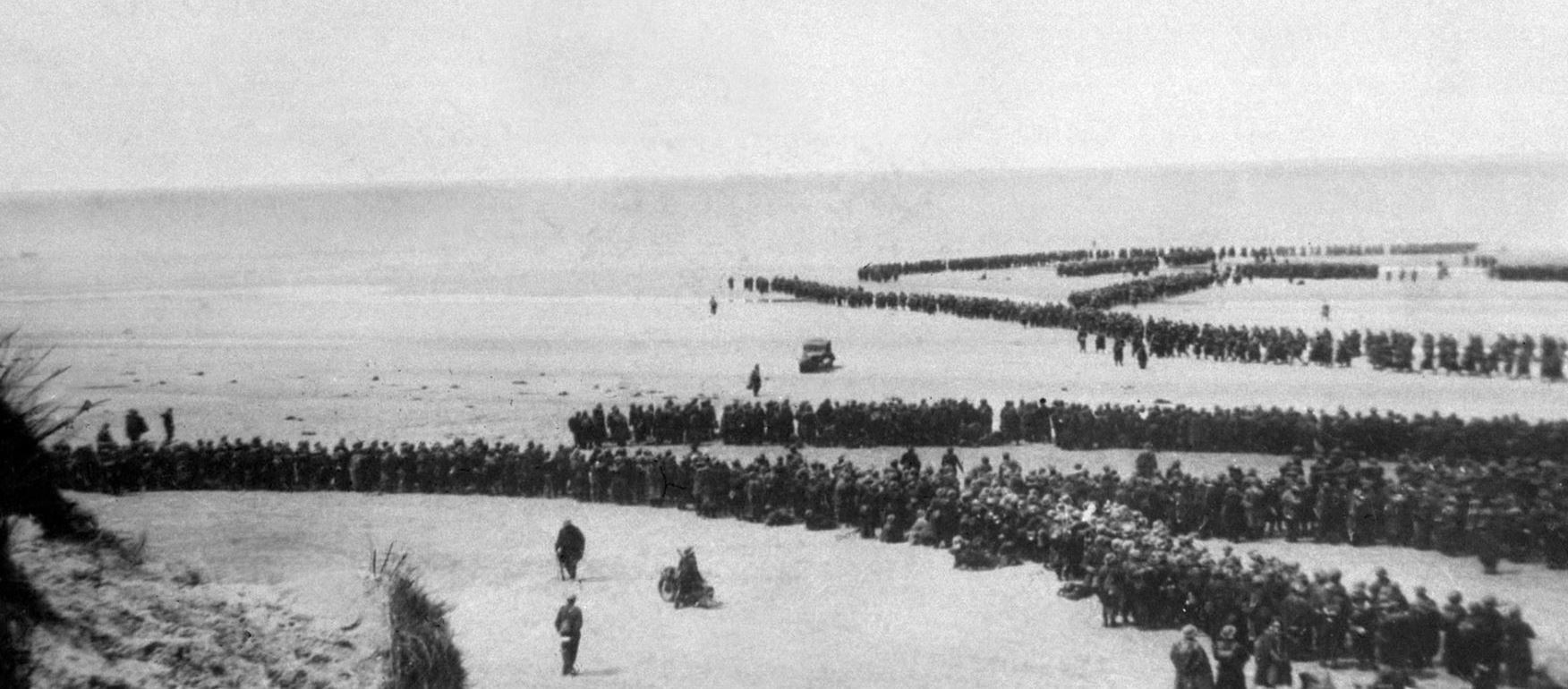
The regiment gathered again in England and moved on 13 June to the western edge of the New Forest, with headquarters at Downton. John Edward rejoined it on 18 June. He had also gained appointment as lance sergeant, effective from 29 May, and returned to the unit with the experience of the French campaign behind him. The men prepared against invasion while replacement guns and vehicles arrived.7
RUSHDEN AND HAZEL
On 11 July 1940, 2RHA moved to Rushden in Northamptonshire, part of the preparation for invasion by Germany which was expected imminently, and the East Anglian coast was seen as exposed and a likely invasion target. Here, under threat of invasion, and with the London Blitz proceeding to the south, John Edward must have met Hazel Shatford. Their relationship developed while the regiment was based in the area, and they conceived a child in October. By October, the Germans had failed to gain air superiority and the threat of invasion had receded. John Edward knew he could be sent off to any theatre of war within hours. Sure enough, at almost no notice, on 30 October the regiment was sent by train to Liverpool and embarked on the Cunard liner Scythia. The destination was secret, though some officers knew they were en route to Egypt. Hazel would not even have known she was pregnant when John Edward left Britain for the Middle East.8 Were they engaged? Did he even have time to tell her they were leaving? Did they even agree to correspond? We can never know.
OFF TO WAR AGAIN
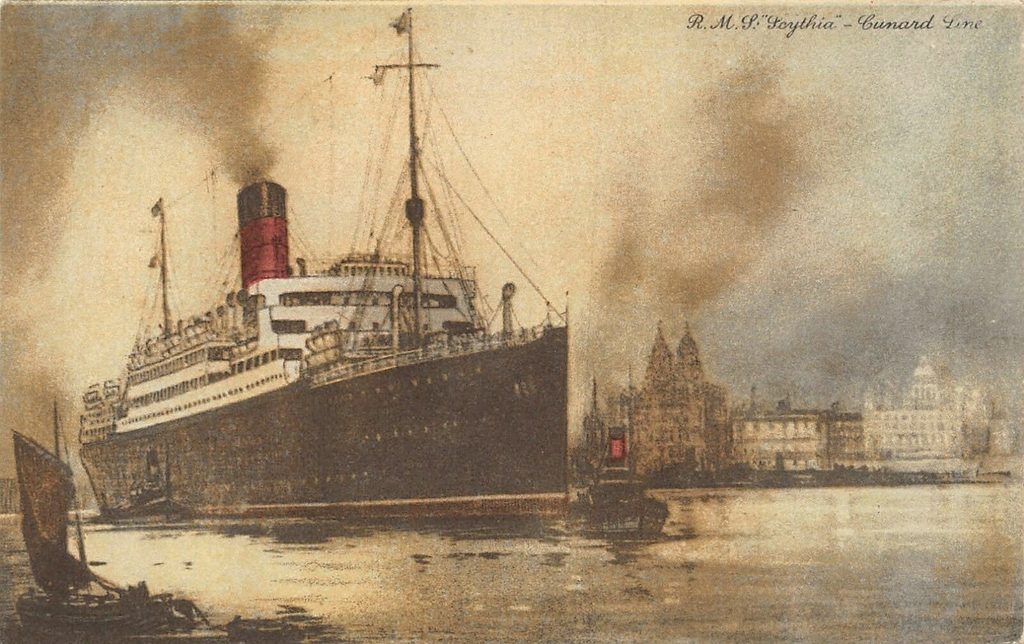
Scythia sailed on 1 November. The passage followed the long route around southern Africa and regular boat drills, lifebelts and blackout precautions kept them within a wartime routine. The ship reached Freetown on 14 November and Cape Town on 28 November. No shore leave was allowed. At Durban the regiment transferred to the troopship Dunera on 3 December. Conditions for ordinary troops were more cramped than on Scythia, particularly at night when blackout restricted ventilation. Training and lectures continued as the convoy crossed the Indian Ocean towards the Red Sea. John Edward turned thirty-one on 11 December, during the voyage. His own battery helped provide entertainment aboard, organising a fancy-dress event on 17 December. The troops celebrated Christmas early on 22 December as they neared Egypt.9 Back home, Hazel would have spent Christmas knowing she was pregnant, and not knowing where her child’s father was.
After nearly eight weeks away from Britain, John Edward disembarked in Egypt in late December. By January 1941, 2nd RHA was at Tahag Camp, training and equipping for desert warfare. Its vehicles had all been landed by 10 January, and practice shoots at Bilbeis on 15 and 16 January helped prepare the regiment to work with infantry. Dust storms were frequent. At the end of February, heavy rain flooded a camp which had previously been dry and dusty.10
GREECE AND ANOTHER RETREAT
The regiment’s preparations for desert warfare were interrupted by the growing threat to Greece. Italy’s invasion in October 1940 had been repulsed, but on 13 December Hitler had ordered preparations for a German attack. On 24 February 1941, the British War Cabinet approved an expedition to reinforce the Greeks, drawing troops from Egypt. German forces began entering Bulgaria on 1 March, bringing the threat to Greece’s northern frontier as the regiment prepared to cross the Mediterranean.
John Edward embarked with 2RHA from Egypt on 9 March and reached Greece on 16 March. The regiment travelled in several parties, its guns, vehicles and personnel distributed among different ships. Once ashore, the road party made a demanding journey north from Athens, through mountain passes and earthquake-damaged Larissa, towards Edessa. On 25 March L/N Battery moved east of Yannitsa to operate with the 4th Hussars.11
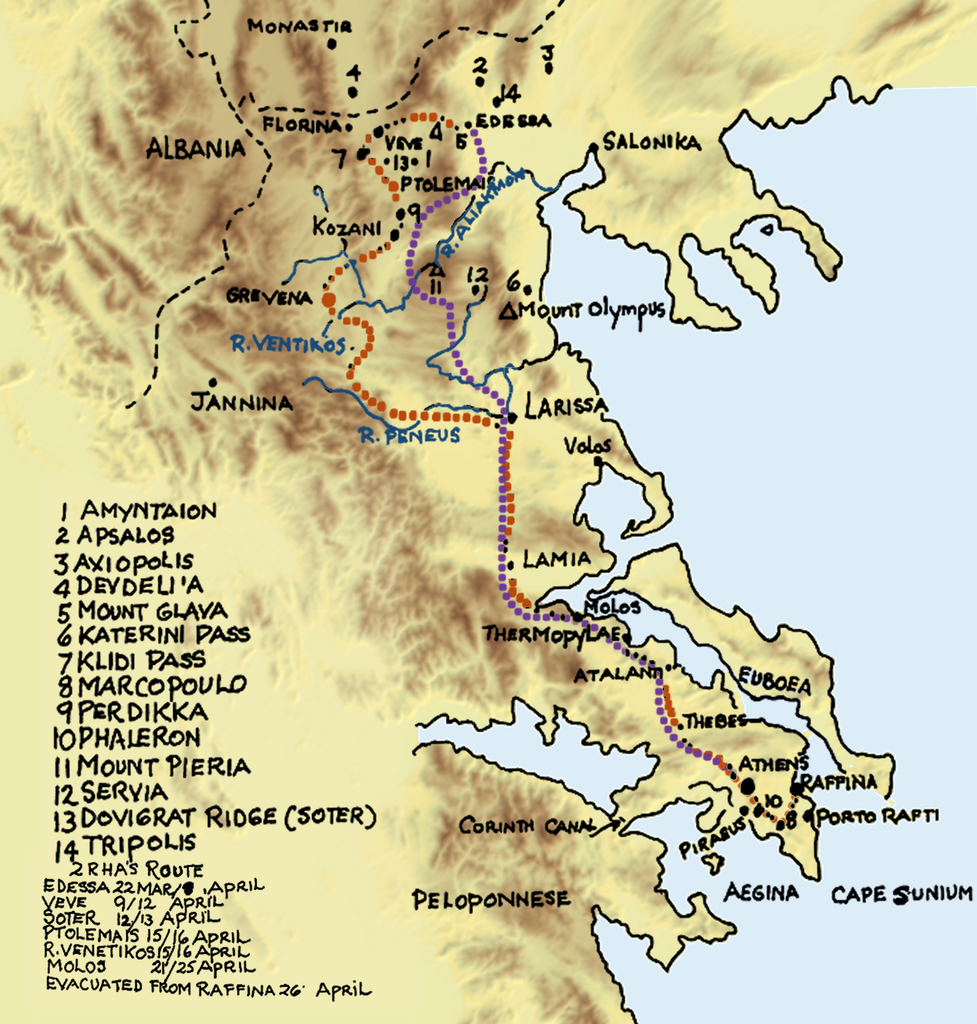
(Map from Christopher Seton-Watson)
The battery’s task was to help delay the German advance through successive defensive positions. Its preparations included reconnaissance, camouflage, trenches and communications, together with careful planning of withdrawal routes. When Germany invaded Greece on 6 April, these plans soon became active operations. On 9 April L/N withdrew through the Verria Pass, covering about 120 miles before rejoining the rest of the regiment.
Between 10 and 13 April the regiment fought around Veve and Ptolemais in snow and intense cold. Heavy enemy attacks forced successive withdrawals. On 13 April L/N engaged tanks over open sights, firing directly at visible targets as German armour pressed forward. That night the regiment withdrew behind the Servia line and crossed the Aliakmon. In three days of fighting it had fired 3,100 rounds.
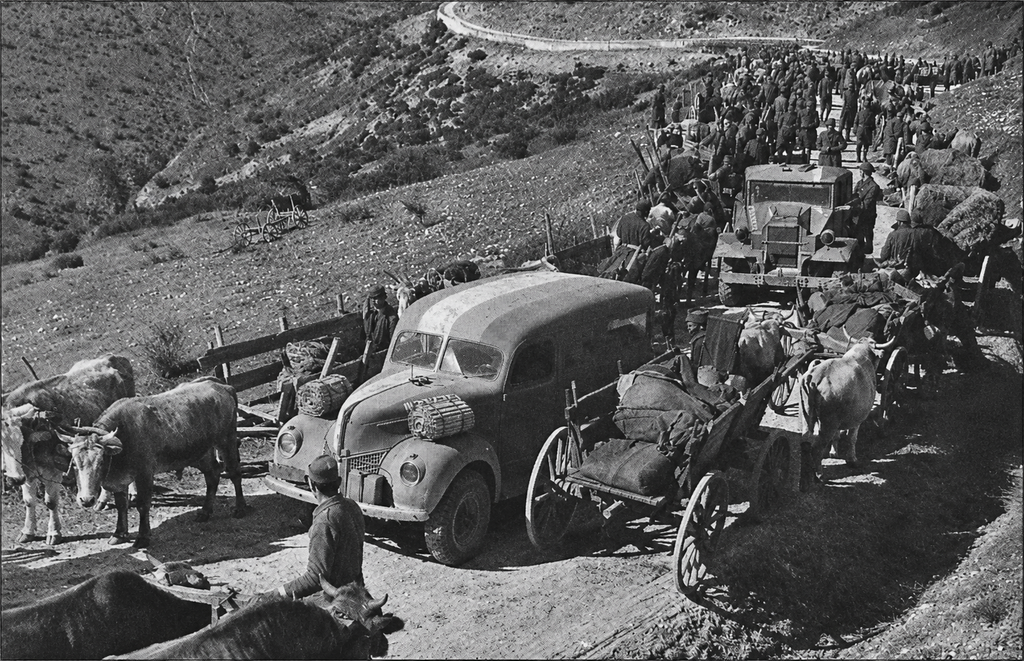
The retreat continued along congested roads, with long night movements and repeated attacks from the air. Bad roads slowed progress and vehicles were lost. On 15 April bombing struck the regiment’s rear transport echelon, killing two men, wounding six and destroying ten vehicles. L/N itself suffered casualties during later air attacks. The guns and their supporting vehicles had to keep moving while the force withdrew south towards the evacuation beaches.
By 23 April evacuation had been ordered. L/N took on a rearguard role, helping cover the withdrawal after other elements of the regiment had begun to leave. On 26 April detachments were still positioned near Tatoi and Malakasa in support of the Rangers before pulling back to the beach that evening. John Edward embarked on 27 April and landed in Egypt on 29 April. Extraordinarily, within eleven months he had evacuated under fire from the BEF and then been evacuated from Greece after another fighting retreat.12 It is difficult to establish how much soldiers on the Greek campaign would have been able to correspond with family during this intense campaign.
THE WESTERN DESERT – AND THE BIRTH OF ROGER ORD SHATFORD
Back at Tahag, the regiment had to rebuild. At the beginning of May its available transport consisted of only two trucks of uncertain age. The men received five days’ leave, and training was initially confined largely to rifle drill, physical exercise and limited specialist work. Later that month L/N contributed a company to a temporary mobile reserve formed against a possible parachute attack on the Suez Canal.
In July 1941, Hazel gave birth to their son, Roger Ord Shatford, while John Edward was in Egypt. After the retreat from Greece, his regiment had moved from Tahag to Beni Yusef on 2 June and remained there throughout July, rebuilding its equipment and training for another campaign. While Roger’s life began in England, his father’s unit was receiving replacement lorries, communications equipment and guns. By 31 July it had been declared ready for war with sixteen 25-pounder guns.13
In early August, 2RHA moved into the Western Desert and came under the 7th Armoured Division – famous as “the Desert Rats”. Its batteries operated in mobile columns rather than always as a single regiment. L/N belonged to Sister Column, with a smaller forward force known as Little Sister. Eagle and Néry Troops alternated between forward positions and the rear. Small gun parties moved out to register targets and engage enemy armoured cars, with much of the work involving observation, preparation and readiness to move.
On 14 September a German advance involving approximately 150 tanks threatened these positions. Sister Column narrowly avoided being cut off, racing the enemy over fifteen miles. L/N engaged enemy observation posts and advancing tanks before withdrawing. The following days brought a return to the previous positions and further patrol work. The battery was relieved on 27 September, and the regiment moved to Rakham Bay for rest and practice shooting. John Edward took leave from 1 to 5 October.
Later in October L/N joined Archie Column. Early in November the regiment came under Brigadier Gatehouse’s 4th Armoured Brigade and prepared for the offensive into Libya. After exercises and maintenance it moved to the Bir Hamra area. Final preparations were made on 17 November, with Eagle Troop placed under the 4th King’s Dragoon Guards to strengthen their reconnaissance force.
OPERATION CRUSADER AND THE BATTLE OF SIDI REZEGH
The Operation Crusader advance to relieve the siege of Tobruk began on 18 November. On 20 November L/N and an accompanying troop of the Northumberland Hussars engaged about thirty enemy tanks at ranges of 1,000 to 1,500 yards, firing over open sights. Five or six were reported hit, and the remaining tanks did not continue their advance. The battery rejoined the brigade that afternoon. On 21 November it supported the 3rd Royal Tank Regiment as the brigade moved north and northwest towards Bir Reghem. Heavy rain fell that evening, leaving L/N bogged down and its men digging out through the night.
The morning of 22 November began with the batteries bogged down again and their men exhausted. A planned engagement of a reported enemy concentration proved fruitless. The brigade was then sent north towards Sidi Rezegh, the strategic airfield which became the epicentre of some of the most chaotic and violent tank battles of the Western Desert campaign, resulting in devastating armour losses for both sides. For the 2nd RHA the battle was confused and information about friendly positions was poor. Observation parties struggled to direct fire while enemy heavy artillery shelled the battery positions. At dusk an attack around the left flank forced a hurried withdrawal eastwards.
During darkness, part of the brigade’s laager, the concentration of men and vehicles, was surprised and captured. The regiment lost five officers and twenty other ranks. John Edward was wounded and taken prisoner at Sidi Rezegh on 22 November 1941. Shrapnel had struck his head.14
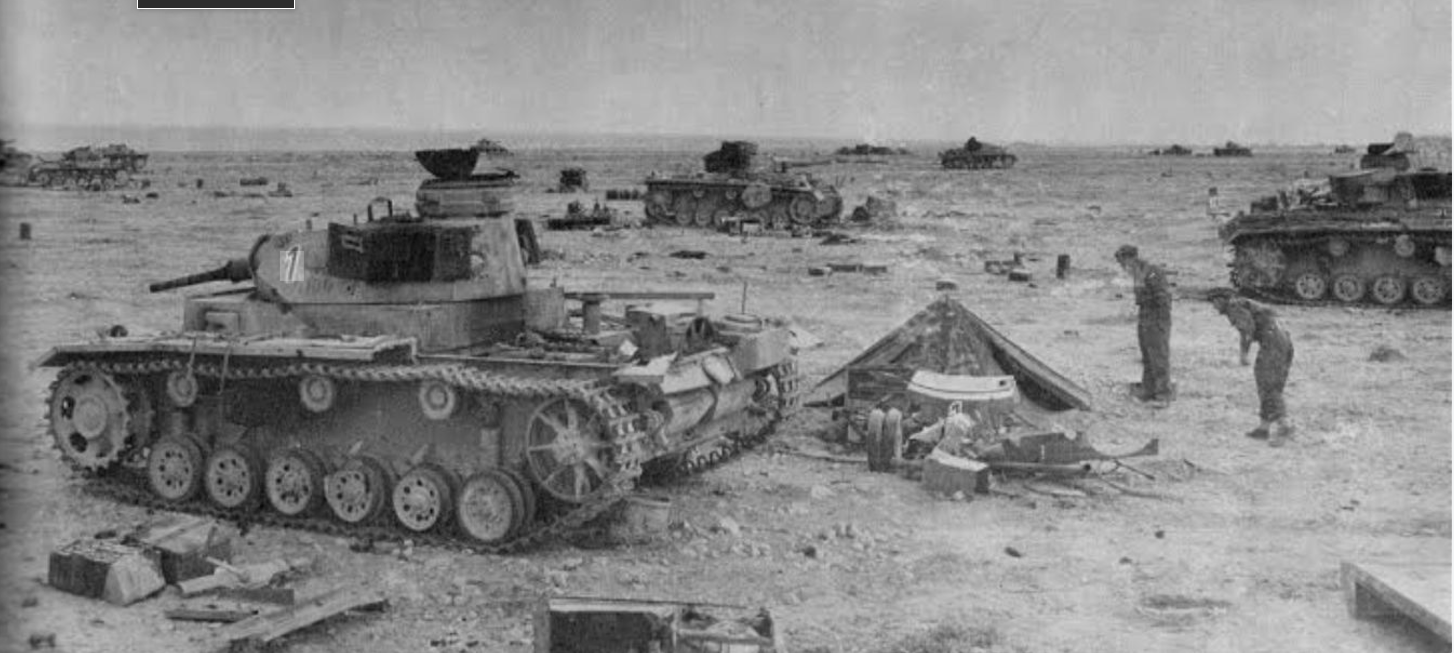
PRISONER OF WAR
From Sidi Rezegh, the standard path for Allied prisoners involved a forced march or truck transport north toward the Mediterranean coast (often through Benghazi or Tripoli). From there, the vast majority of prisoners captured during Operation Crusader were packed onto cargo ships and sent across the sea to POW camps in Italy.
British officials initially reported him wounded, then missing, before confirming that he was a prisoner. By early December he had been reported in the military hospital at Caserta, Italy. His head wounds required treatment into March 1942. In his later account he described medical care as inadequate and wrote that Caserta hospital suffered shortages of medical supplies.15 Incoming prisoners arrived suffering from severe malnutrition, exposure, and dysentery. Rations inside the main camp were infamously meagre, consisting of weak water-and-rice soup and a few ounces of bread, leaving prisoners reliant on early Red Cross shipments to survive.
He spent the first months of 1942 within the Camp 66 system at Caserta, including a hospital stay from 1 January to 15 March. On 16 April he moved to Camp 65 at Altamura, where he stayed for more than a year, until 18 June 1943.
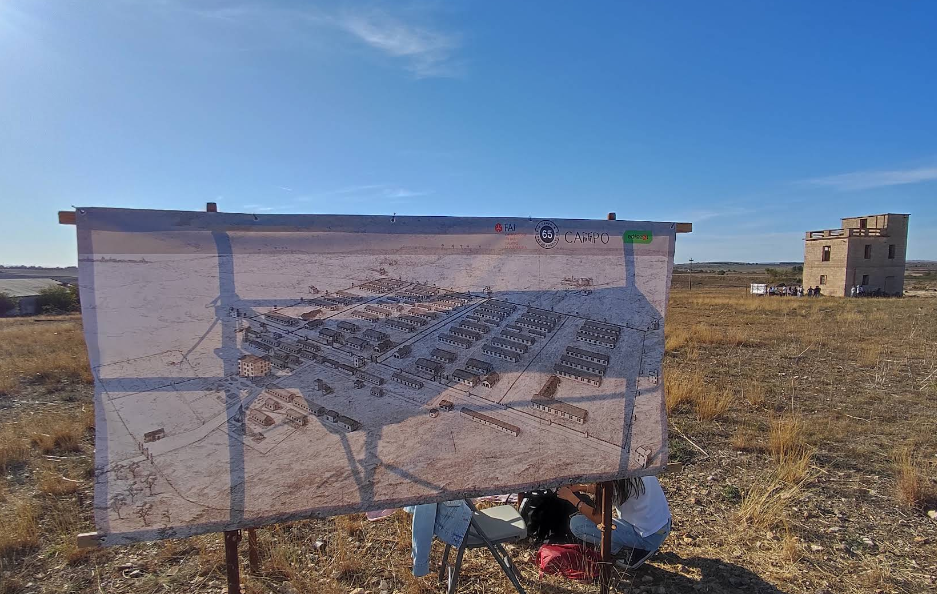
Located in the Puglia region of southern Italy, Campo 65 was one of the largest Allied POW camps in Italy. It was a purpose-built facility specifically to hold NCOs and troops captured in North Africa and consisting of rows of brick and concrete barracks. By mid-1942, it was notorious for overcrowding, strict discipline, and meagre food rations, though the prisoners managed to organize concerts, sports, and educational classes to keep their spirits up.
He then passed to Camp 70 near Fermo, Marche region, near the Adriatic coast, arriving on 20 June and remaining until 22 September.16 On 8 September 1943, Italy surrendered to the Allies. At many camps, British commanders ordered the men to “stay put” and await Allied rescue. However, the German army acted instantly, launching Operation Achse to seize control of Italy and round up Allied POWs before they could escape or be liberated. German forces surrounded Camp 70, loaded the prisoners onto cattle trucks, and transported them north into the Third Reich.
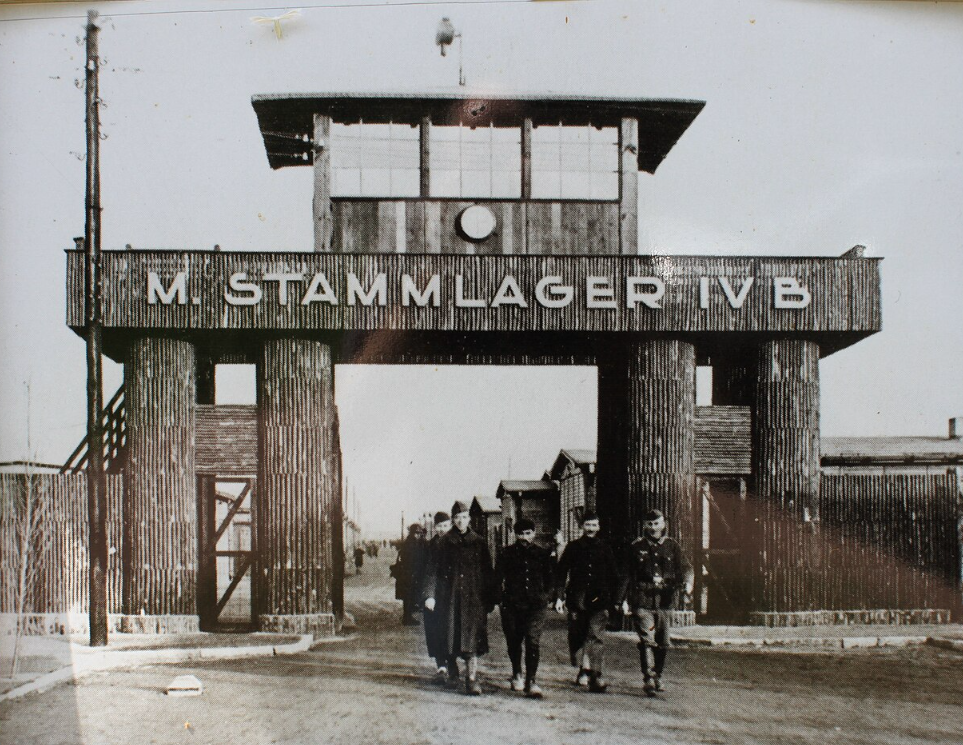
On 27 September 1943 he entered Stalag IV-B at Mühlberg in Germany about 30 miles north of Dresden. Stalag IV-B was one of the largest prisoner-of-war camps in Germany, housing tens of thousands of soldiers from across the Allied nations. His German prisoner number was 260529 17 and he remained there until 23 April 1945.
BARBED WIRE UNIVERSITY
As an NCO he was not liable for labour camp work. Instead he pursued radio-engineering studies hoping to become an Associate Member of the British Institution of Radio Engineers (Brit IRE). The Brit IRE actively participated in the Directorate of Army Education’s scheme to send study syllabi and professional exams into German Stalags. The Brit IRE would pack the specific radio engineering textbooks, past papers, and eventually a sealed exam packet, sending it back through the Red Cross mail lines to Germany. The camp featured a technical library supported by Red Cross parcels, and it hosted structured evening lectures where experienced engineers taught the advanced mathematics, physics, electromagnetic theory and radio communication engineering required to pass the Brit IRE boards.
Overall, the educational initiative at the Stalags grew so large that it earned the nickname the “Barbed Wire Universities.” Exams were strictly invigilated inside the camp barracks to maintain the institutional integrity of the qualification. Senior Allied officers acted as official exam proctors. They enforced strict time limits, forbade cheating, and certified that the papers were completed under standard academic conditions. Once finished, the completed handwritten exam scripts were collected, sealed, and sent back across active war zones via Red Cross diplomatic mail bags to London, where professional panels marked the papers.
John Edward reported that he took an examination whose result was still unknown to him when he completed his post-war report. By then he described his civilian trade as radio mechanic. I have been unable to confirm whether he ever completed this qualification.
LIBERATION
In February 1945, the prisoners at Stalag IV-B would have easily seen the glow and felt the vibrations of the catastrophic Allied bombing of nearby Dresden. 23 April 1945 was an historic day for Stalag IV-B. On this morning, the Soviet Red Army (5th Guards Army and specifically “four tired looking horses carrying four more lethargic Cossacks” and, famously, a unit spearheaded by three Russian women tank drivers) advanced into Mühlberg and liberated the camp. At the time of liberation, there were roughly 30,000 prisoners in the camp. The Soviets refused to let the British and Americans go until they could secure a reciprocal agreement ensuring the Western Allies would return all Soviet citizens and prisoners found in the West. But in May 1945, the Soviets finally began clearing the main camp. The British prisoners were marched roughly 15 miles south to the town of Riesa, which was also under Soviet occupation. Once the formal, flag-waving military exchanges between Soviet and American officers were completed on a designated field near Riesa, the British troops were loaded into American trucks and driven to the airfield at Halle. From there, they were flown by Dakota transport aircraft to Brussels, then home to the UK for medical evaluation and repatriation.
HOME TO WELWYN GARDEN CITY
John Edward returned to Britain on 28 May 1945, aged thirty-five, after approximately three and a half years in captivity. His mother had died on 15 January that year – he had not seen her since June 1940. Roger was by then nearly four years old, and Hazel had married American soldier Carl Buster Bostic, given birth to their son Michael, and changed Roger’s name to Bostic. We will never know if John Edward knew of Roger’s existence, or whether he went to look for Hazel.18 All we do know is that Carl Buster never returned, and Hazel was left a single mother again with two young sons. Roger never knew anything more about his father, and assumed he was dead.
On 25 October John Edward joined No. 1 Civil Resettlement Unit at Hatfield House, close to Welwyn Garden City. The unit helped returned prisoners prepare for civilian life, providing practical advice and assistance with employment.19 He left on release leave on 21 March 1946. His service was recognized by the 1939–45 Star, the Africa Star and the War Medal. Almost seventeen years after his enlistment, and after campaigns in France, Greece and North Africa followed by captivity in Italy and Germany, he returned to civilian life.20
WHAT HAPPENED TO THE ORDS?
John Edward married Marguerite Isobel Parker in 1947. She was a widow or divorcee, with the married name Forster. It appears that he and his wife moved into his parents’ home where they looked after his father.
1947 also saw the wedding of the youngest sibling Joyce to Maurice McCullie. Joyce died in 1981 aged 58. Both she and her husband are interred in her parents’ grave in Welwyn.
John Edward’s sister Phyllis had married Ernest John Fricker from Hatfield in the midst of the London Blitz late in 1940. She had two children, Margaret in 1944 and John Edward in 1947 – presumably named for his recently returned uncle. Phyllis died in 1992 aged 80 and was interred in her parents’ grave.
James Alfred married Joan Horne during the war in the summer of 1943. I have not managed to trace their children. He died in 1991 aged 73, certainly in the Hatfield area, possibly in Welwyn. He and his wife were also interred in his parents’ plot.
In 1954 John Edward’s niece Billie (only daughter of his eldest brother William) gave birth in Welwyn to her first child Christopher, to be followed in December 1956 by Stephen. In 1960 Billie and her family emigrated to Australia, and William died on Christmas Eve 1970, still living in Welwyn Garden City.
The third son, Benjamin Winship Ord jr, married Sarah Ellen Bailie McMillan, from Co Down in Northern Ireland. She was working for the Ministry of Labour at the Wood Lee rehabilitation centre in Chertsey, Surrey just after the war (and possibly during it). The centre helped injured service members and civilians to return to active working life. By the 1950’s they were married and had a son David in 1953. They settled in Belfast where Benjamin died in 1986. David returned to Welwyn Garden City in the 1970’s before returning to Ireland to marry, and then lived again with his family in Welwyn Garden City in the 1980’s. He died in Surrey in 2017.
Benjamin Winship Ord (senior) died in 1956 at the age of 73. He was buried with his wife Margaret in Hatfield Hyde Cemetery in Welwyn.
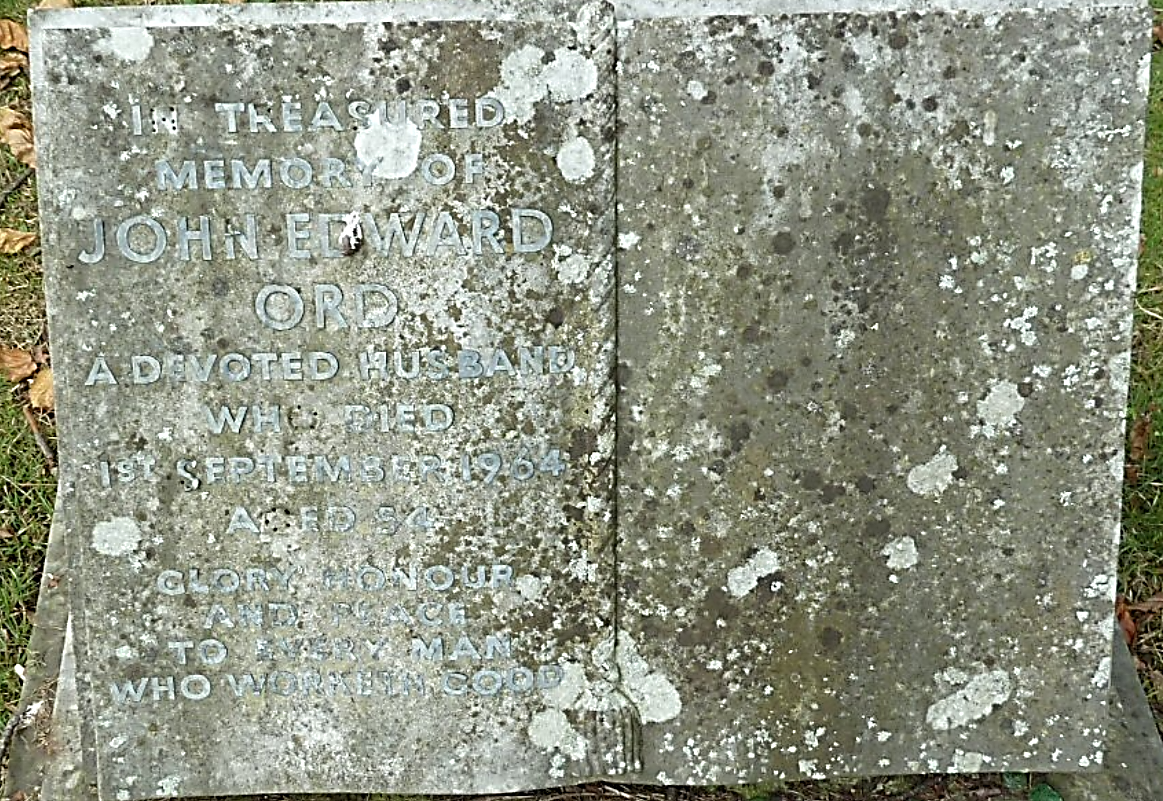
John Edward Ord died in Welwyn Garden City on 1 September 1964 aged 54. He never met his only son, Roger Ord Shatford Bostic. Like his parents, he was buried in Hatfield Hyde Cemetery. Marguerite described him on the gravestone as “a devoted husband” and quoted from Romans 2:10: “glory, honour, and peace, to every man that worketh good”. There was space alongside for her epitaph, but in 1967 she remarried Iain Cameron, and her place of burial is unknown. So the space next to John Edward’s inscription remains blank.
It is an extraordinary coincidence that when Roger met his future wife, she was living just south of Hatfield and both Simon and his brother Andrew were born in Welwyn Garden City in the Queen Elizabeth II Hospital just a half mile from this cemetery.
Notes
- Service record. ↩
- Service record.↩
- The military papers change his father’s address from 7 Blossom Street, Hetton-le-Hole, to 33 Knella Road, Welwyn Garden City. The 1945 questionnaire independently gives 33 Knella Road as John Edward’s private address. ↩
- The battery identification follows the service-record unit entries and the 1941 diary. ↩
- Christopher Seton-Watson, Dunkirk–Alamein–Bologna (1993), pp. 15, 21 and 23–36. These are broad regimental movements; the memoir’s detailed gun actions are principally those of the author’s H/I Battery. ↩
- Seton-Watson, pp. 37–39. ↩
- Seton-Watson, pp. 44–49. ↩
- Seton-Watson, pp. 49–54, later explicitly places L/N aboard Dunera. ↩
- Seton-Watson, pp. 52–54. ↩
- Tahag and Bilbeis are documented in the January–February entries of WO 169/1427. ↩
- John Edward’s dates come from his service record. WO 169/1427 states the main personnel party travelled on Hellas, reaching Piraeus on 15 March; the vehicle ship arrived on 16 March. His particular ship is not identified. The diary records a 372-mile road journey, while guns and some personnel travelled by rail. ↩
- The April entries of WO 169/1427 establish L/N’s rearguard duties. John Edward’s embarkation and landing dates are personal entries. The main regimental party boarded Glengyle late on 26 April and sailed early on 27 April, but his individual vessel is not named. ↩
- The War diary locates the regiment at Beni Yusef for July; no separate individual location or absence is recorded for John Edward that month. ↩
- The date comes from the service record; the 1945 POW report explicitly identifies Sidi Rezegh, Libya, as the place of capture and confirms that he was wounded. It describes head wounds caused by shrapnel. The diary’s night attack is a strong possible context, but John Edward is not named among the twenty other ranks, and the exact circumstances of capture are not known. ↩
- The service record reports Caserta hospital on 3 December 1941 and arrival at PG66 on 29 December. In his 1945 questionnaire John Edward dated his period of head wounds from 22 November 1941 to 15 March 1942. Asked whether treatment was adequate, he answered “No” and referred to shortages at Caserta. ↩
- These are John Edward’s own camp dates on the 1945 questionnaire. He describes Caserta hospital as part of Camp 66. ↩
- Prisoner number comes from the service record. ↩
- The date of return comes from the service record; 23 April on the POW questionnaire is the end of the Stalag IVB stay. ↩
- The resettlement posting appears in the service record; Hatfield House and the unit’s purpose are identified in the Wellcome Collection’s Civil Resettlement Units archive description. ↩
- The service record states the medals awarded and date of release. ↩